
Program unveils website refresh and opens applications for the next cohort of circular solutions.
What if the next big step for Michigan’s economy is already sitting in a recycling bin, a compost pile or a warehouse of reusable materials? For five years, NextCycle Michigan has helped entrepreneurs, communities, and industry partners turn discarded materials into new opportunities, strengthening reuse, repair, recovery and recycling across the state. These solutions are about more than achieving recycling and environmental goals – they also represent a significant economic opportunity for Michigan. When the state reaches a 45% recycling rate, an estimated $33 billion in economic output could be generated to support Michigan's economy. Michigan is already making progress toward the goal, with a record-high 26% recycling rate reported this year.
The NextCycle program is funded by the Michigan Department of Environment, Great Lakes, and Energy (EGLE) and supports initiatives that divert materials from landfills and keep them in use for their next functional purpose. Built on innovation and collaboration, the program offers a project accelerator, funding pathways, and an extensive partner network to develop and scale circular initiatives. The program was developed and is facilitated by Resource Recycling Systems, Inc. (RRS), with support from industry experts including the Michigan Recycling Coalition, Fresh Coast Climate Solutions and other strategic partners across the state.
“Waste is a global problem; however, solutions need to take on a local lens,” said Julie Staveland, assistant division director at EGLE. “That’s where NextCycle Michigan puts a spotlight on gaps in our regional material recovery infrastructure and end-markets and provides practical support to the innovators and changemakers who have solutions.”
NextCycle Michigan has conducted three Gap Analyses that identify clear needs within the state. The latest data from the 2025 report indicated that 85% of the 8.5 million tons of waste could be recovered with the proper infrastructure and end markets. Within that waste stream, nearly 40% is food scraps and organics. Additionally, the analysis identifies plastic film as the second-largest material by weight and cardboard is still under-recovered in the state. Recently, NextCycle Michigan conducted a special consumer battery gap analysis to establish a baseline understanding of consumer battery recycling behavior and access to recycling programs.
Data from the gap analyses has guided the program’s accelerator focus and participant selection. Whether supporting public-led initiatives that expand access to recycling, collaborative partnerships that divert surplus food to food pantries, or entrepreneurial start-ups that develop new technologies to utilize recovered materials, the accelerator moves initiatives toward implementation and scaling. Each accelerator cohort receives free operational and technical coaching, access to potential partner connections and funding pathway identification.
Several NextCycle Michigan teams reflected on their experience with the program:
“As a small rural county, we did not have the capacity or expertise to plan and launch a county-wide program. NextCycle Michigan supplemented the funding and knowledge we needed,” said Jamie Carruthers-Soboleski with Iosco County about their experience with NextCycle as they developed drop-off sites for recycling paper, cardboard, plastic containers and glass.
“NextCycle has helped to make connections with potential pilot partners and other plastics recycling organizations in the state,” said Georgia Crowther, founder and CEO of The Reclamation Factory, a robotic recycling startup using audio signatures to sort plastics by color, shape and resin.
“The NextCycle program has helped me format a model to expand my business into rural communities, which is very exciting,” said Megan Alexander, owner of Carter’s Compost in Traverse City.
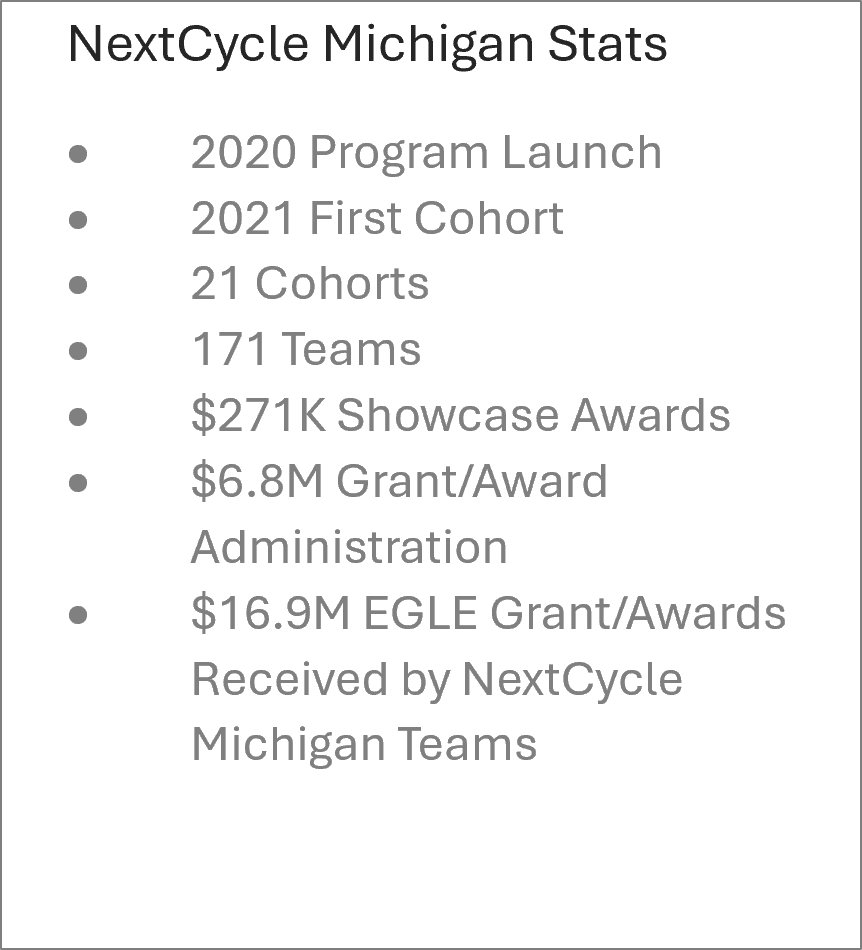
In addition to the accelerator, NextCycle Michigan offers funding opportunities through EGLE to advance circular initiatives. The Circular Economy Grants provide large-scale funding for proven projects, while the Seed Awards provide small-scale funding for projects just getting started. Participants in the accelerator showcase their solutions during a pitch competition at the end of each cohort for monetary awards, with some cohorts receiving a Harvest Grant from EGLE to continue advancing their projects. These grant funds are further leveraged by partner dollars, such as a recent sponsorship by DTE to support recycling of wood waste and wind turbine blades. EGLE has awarded approximately $6.8 million in grants through NextCycle Michigan since 2021, and awarded nearly $17 million in grants to NextCycle teams.
The Michigan Materials Marketplace is another tool offered by NextCycle Michigan in collaboration with Rheaply. The free online platform enables organizations to buy, sell or donate used office equipment and furnishings. Additionally, the platform hosts virtual roundtable discussions focused on specific material challenges and solutions.
NextCycle Michigan has also created a partner network that brings together industry networks, investors, and organizations with shared goals to enable local circular economies to grow within the state. Through this network, NextCycle facilitates support for shovel-ready work, connects organizations to accelerator participants to encourage collaboration and industry integration, and deploys investments to ready solutions.
“Since launching in 2020, NextCycle Michigan has continued to grow, offering tailored support, funding pathways and building a robust partner network,” said Elisa Seltzer, senior consultant with RRS and project director for NextCycle Michigan. “We have start-ups, nonprofits, manufacturers, impact investors and local organizations coming to the program seeking ways to engage and implement sustainable solutions.”
The NextCycle Michigan Accelerator is currently seeking applications through October 22, 2026, for initiatives that incorporate novel recycling technologies and projects focused on organic waste stream solutions.
Recycling Technology Solutions: Projects that advance or scale cutting-edge technologies or innovative processes in waste prevention, reuse, redesign or recycling. This includes, but is not limited to, material collection and sorting innovations, recovery and processing technologies, waste minimization and reuse techniques, recycled product designs, new uses of recycled content, design for reuse, end market development or any other circular designs for materials and products.
Organics Solutions: Projects focused on organic waste streams, such as reduction or recovery of organic materials, composting systems and infrastructure improvement, development of new end markets for organic materials, anaerobic digestion technologies and more. Relevant organic waste materials include food scraps, agricultural waste, wood waste, organic liquids and related organic materials.
A virtual information meeting on September 23, 2026, will give those interested an opportunity to learn about the program and ask questions. Register for the meeting at: Info Meeting.
Additional upcoming opportunities to get involved include:
Sept/Oct 2026: Application Period (Recycling Technologies & Organic Material Solutions)
Nov 2026: Fall Showcase (Public-Led and Recycling Supply Chain Solutions)
Feb/Mar 2027: Application Period (Public-Led and Recycling Supply Chain Solutions)
Apr 2027: EV Battery Reuse & Recycling Showcase
June 2027: Summer Showcase (Recycling Technologies & Organic Material Solutions)
Visit the refreshed website at www.NextCycleMichigan.com to learn more about the program.